Separate the genuine design from the replica material claim
The genuine Day-Date family has 36 mm and 40 mm designs, a full weekday window at 12 o'clock, a date at 3 and a President bracelet. Rolex offers the genuine family in precious metals. A replica's case, coating and bracelet require their own material description.
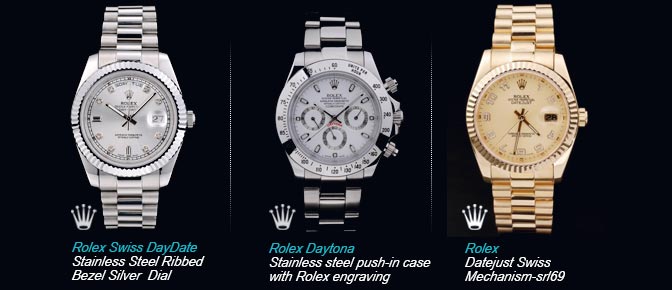
The left-hand watch in this site's original three-watch image is a Day-Date-style layout. The image's steel advertising description concerns that pictured replica offer; it is not evidence that the genuine Day-Date is a steel model. Likewise, a gold-coloured photograph does not measure the metal content of either the case or bracelet.
36 versus 40: give the display and bracelet room to work
A smaller case creates a more compact visual footprint; a larger design gives the weekday window and dial more presence. The useful result depends on the replica's actual dimensions and lettering. Compare both sizes with the same dial and bezel direction so brightness or decoration does not masquerade as a size effect.
| Priority | 36 direction | 40 direction | Record for each watch |
|---|---|---|---|
| Case presence | Start here for a smaller footprint. | Start here for a larger dial presence. | Diameter without crown, lug span and rigid end-link extension. |
| Weekday reading | Check the longest word at normal reading distance. | Check whether the extra visual area actually improves your reading. | Language, full-word visibility, contrast and camera conditions. |
| Cuff clearance | Do not assume a smaller diameter also means a thinner case. | Compare the side profile with the same cuff. | Actual thickness and side-view evidence. |
| Bracelet sizing | The minimum usable length may decide the fit. | The clasp's position after sizing may decide the fit. | Removable links, adjustment positions and shortest usable length. |
There is no wrist-circumference cutoff supplied here for either replica size. Use a comfortable existing watch as a footprint reference, and leave absent measurements unknown rather than assuming the genuine design label describes every replica case.
Read the full week in the chosen language
Check seven distinct weekday positions on the same watch. In an English display, that means Monday through Sunday, including the longer Wednesday and Thursday text. A short word centred neatly does not establish that every longer word clears the window.
| Item | Evidence | Result and follow-up |
|---|---|---|
| Weekday language | All seven settled weekday views. | Record the actual language, spelling and any mixed-language wheel. |
| Weekday centring | Square-on images of both short and long words. | Distinguish a consistent offset from one printing position or an obstructed long word. |
| Date centring | Several settled dates, including one and two digits. | List the dates shown and whether the apparent offset repeats. |
| Calendar transition | A continuous observation across the actual change. | Record when each display begins moving and when it fully settles. |
A longer word occupies more of the window naturally. If letters are clipped or the baseline remains displaced in a straight-on view, record that separately from word length. If only one weekday is shown, the other six remain unverified.
Observe the day and date as two functions
The genuine design changes both displays around midnight. A replica may have a different calendar mechanism, including a gradual or staged transition. Record the day and date individually: both change, only one changes, either hangs between positions, or the transition has not been observed. Do not assign a universal transition-time tolerance to every replica.
Initial crown positions and any calendar quick-set restrictions depend on the installed movement. Demonstrations and subsequent use should follow that mechanism's instructions, not an assumption based on the dial. The movement identification guide explains which information distinguishes a working day/date movement from a copied reference-calibre label.
A useful demonstration begins with both displays settled, follows the actual transition and ends with the next day and date fully visible. It should establish the starting date and whether the time is before or after noon. That avoids mistaking an incorrect initial setting for a demonstrated calendar fault.
Material, coating, colour and weight answer different questions
| Field | What to record | What it can decide |
|---|---|---|
| Base material | The stated case and bracelet metal, with any supporting evidence. | What the parts are claimed to be made from. |
| Surface treatment | Plating/coating description and which components it covers. | Whether the gold-coloured appearance is a surface finish or a claim of solid material. |
| Colour | Case, bezel, clasp and adjacent links under the same light. | Whether the visible components match the appearance you want. |
| Weight | Measured weight with the bracelet size and removed links noted. | How that assembled watch feels; weight alone does not prove gold content. |
A material description for the case does not automatically describe the bracelet, screws or clasp. Colour and weight can guide a wear preference, but they are not substitutes for evidence of precious-metal composition.
Finish the choice with the sized bracelet
The President-style bracelet's rounded link appearance is part of the Day-Date's visual identity. Compare the actual link articulation, clasp closure and case-to-end-link fit. The important sizing question is how it sits after links have been removed: the clasp should lie comfortably rather than rotate to the side because the two bracelet sections were shortened unevenly.
Record the calendar results, material description and usable bracelet arrangement in the inspection record. If a weekday window adds little to your use, the Datejust is the more direct date-only comparison, with its own bezel and Jubilee/Oyster-style choices.