Why the central hand may not move
In ETA's standard 7750 operating diagram, the central hand is the chronograph seconds counter. The small seconds display at 9 o'clock shows normal running seconds; the counter at 12 measures elapsed minutes and the counter at 6 measures elapsed hours. When timing is stopped and reset, the chronograph hands are at zero while ordinary time continues.
Begin by mapping each hand to its claimed job. A motionless central hand with advancing small seconds is different from a watch where ordinary time has stopped. A different subdial arrangement needs its own map: a relocated counter, decorative display or different movement can change the interpretation. For Rolex-branded Daytona layouts, continue to the Daytona function guide rather than applying the standard 7750 positions automatically.
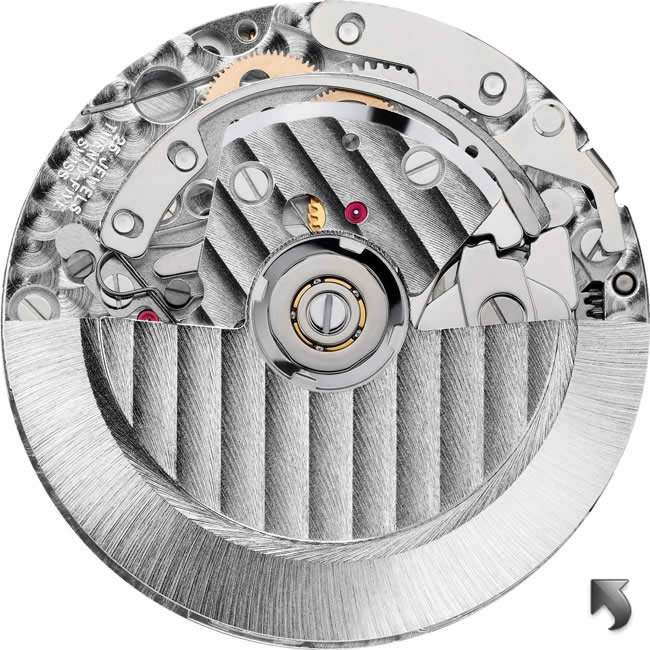
The identified ETA 7750 reference
The following describes ETA's own movement, not every watch advertised as “Asian 7750.” The current manufacturer record was rechecked on 14 October 2026.
| Item | Listed specification |
|---|---|
| Movement package | 30.00 mm diameter; 7.90 mm height |
| Chronograph | Cam-controlled, two push buttons; 60-second, 30-minute and 12-hour counters |
| Other displays | Hours, minutes, small seconds, day and date |
| Winding and setting | Unidirectional automatic winding; stop-seconds; quick calendar correction |
| Frequency and jewels | 28,800 vibrations/hour; 4 Hz; 25 jewels |
| Reserve | Typical 54 hours in the current listing |
The current portal links technical communication version 18, with an entry dated 14 August 2026. Its current listed reserve should not be assigned to every older or modified example without checking that example's documentation. Frequency terminology is explained in the ETA movement guide.
A five-stage chronograph observation record
Use this table to record a seller's demonstration or an appropriately supervised check. Only operate a watch yourself when its movement and instructions are identified. The sequence is not a setting manual for an unknown replica. Add the unit identifier, date and actual elapsed duration to the record; no test results are supplied below.
| Stage | Observation and its meaning | Your result / time / evidence |
|---|---|---|
| 1. Ordinary running | Identify advancing running seconds and ordinary time. This distinguishes ordinary running from the central timing hand's reset state. | — |
| 2. Start timing | The claimed timing seconds hand begins accumulating elapsed seconds. This shows a start response during the demonstration. | — |
| 3. Accumulate time | Record an interval exceeding one minute for the minute register. Record a separate sufficiently long interval, such as an hour, for the hour register. A short clip cannot verify hour accumulation. | — |
| 4. Stop timing | The elapsed-time indications hold their readings while ordinary time continues. Record the readings and the stop moment. | — |
| 5. Reset after stopping | The elapsed-time hands return to their zero indications. Record each hand, rather than only the central hand. | — |
Record resistance, visible hand contact, an unintended jump, a counter that fails to accumulate, or an off-zero reset as a separate observation. Stop further operation if there is unusual resistance or contact and arrange inspection. An off-zero hand can require diagnosis; it is not, by itself, an identification of the underlying cause.
A continuous timed demonstration provides more context than isolated photographs. Cuts between stages or a second watch appearing in the video leave continuity unresolved. Even a complete demonstration documents operation under those conditions, not future reliability or long-term accuracy.
Why a 7753 label changes the setting instructions
ETA's separate 7753 product record includes a date-correction push button at 10 o'clock. The 7750 operating diagram uses its crown for rapid day and date correction. This is an instruction-identification difference, not a complete comparison of every 7750 and 7753 variant.
If a listing changes between these two names, resolve the actual reference and controls before correcting the calendar. The similar listed package dimensions do not make the setting procedure interchangeable.
Operating notes for an identified standard ETA 7750
ETA's operating instructions, document 414 900, version 01-1 dated 26 January 2012, show start, stop and reset in that order. They also show restarting after a stop to add further elapsed time. Their rapid day/date correction restriction covers 8 p.m. to 2 a.m.; do not use rapid correction during that window on the documented mechanism.
The instructions apply to the standard identified reference. A replica with modified controls needs instructions for its fitted mechanism. Use the movement identification notes before transferring an original manual's crown positions to an unknown watch.
What to resolve after the function check
Save the hand map and observation record with the actual manufacturer/reference and the repairer's parts assessment. Decorations and rotor lettering may alter the view without establishing those details. For case sealing, fit and after-sales terms, use the quality checklist; those checks are separate from the timing functions recorded here.