Seven families compared
This matrix compares the intended layouts and design choices. It does not assume that a replica implements every original function. The Explorer guide covers both the time-only Explorer and the distinct Explorer II with its date and 24-hour display.
| Family | Display to look for | Design and daily use | Why choose it; when to compare another |
|---|---|---|---|
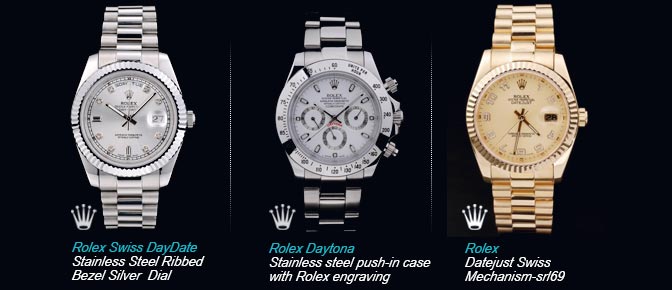
| Datejust | Time and date | An everyday calendar with smooth or domed and fluted bezel choices, plus different bracelet patterns. | Start here for a date without extra counters. Compare Day-Date if the weekday matters, or Oyster Perpetual if you prefer no date window. |
| Day-Date | Time, date and full weekday | A more prominent calendar layout with President-style bracelet options. | Choose the layout for a readable weekday and a formal bracelet appearance. Datejust is simpler if the extra calendar is unnecessary. |
| Submariner | Time, with date or no date; elapsed-minute bezel | A sport-watch layout with an external timing scale. | Choose it for the rotating minute scale and date/no-date choice. Compare GMT-Master II if another time zone matters more than elapsed minutes. |
| GMT-Master II | Time, date and 24-hour hand; rotating 24-hour bezel | A travel-style display with several bezel and bracelet configurations. | Choose a functioning second-time-zone display for reference-time reading. Confirm the setting method; a coloured bezel alone is insufficient. |
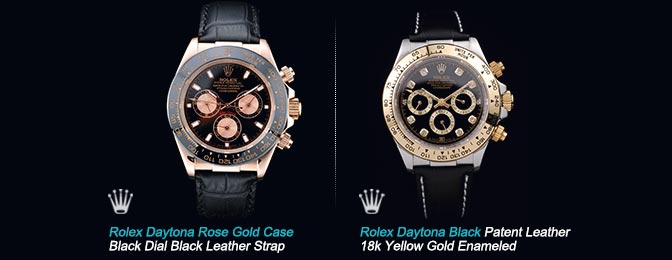
| Daytona | Time and chronograph counters | A busier dial with pushers and an elapsed-time display. | Choose it when the counter layout is part of the appeal or timing is needed. Check working counters; use Datejust if a calendar is the priority. |
| Explorer / Explorer II | Explorer: time only; Explorer II: date and 24-hour hand | Explorer has prominent 3-6-9 numerals; Explorer II has a fixed 24-hour bezel. | Choose Explorer for a simple numeral-led dial. Explore the II separately for reference-time reading; GMT-Master II adds a rotating scale. |
| Oyster Perpetual | Time only | A restrained layout that leaves size, dial colour and markers as the main choices. | Start here when a clean dial and colour choice matter most. Compare Explorer for prominent numerals or Datejust for a date. |
Choose by the display you will use
For a daily calendar: shortlist Datejust and Day-Date. Decide whether seeing the weekday is worth the extra aperture before choosing case size or finish. This separates the functional choice from the bracelet and bezel choice.
For another time zone: shortlist GMT-Master II and Explorer II. A verified independently adjustable local hour is convenient when changing location; an independently set 24-hour hand can suit someone who mainly checks another location while staying at home. The GMT setting guide explains the difference.
For occasional timing: an elapsed-minute bezel can provide a simple visual reference, while a working chronograph records elapsed seconds and counter totals. Choose Submariner styling for the former or Daytona for the latter. These functions have different reading methods; neither a diving appearance nor a working timer establishes water resistance.
For a clean everyday dial: compare Explorer and Oyster Perpetual first. This avoids paying attention to complications you will not use. Actual dimensions and bracelet fit still decide whether the particular watch is comfortable.
Resolve three close alternatives
Datejust or Day-Date?
Choose Datejust when the date is enough and you want to explore bezel and bracelet combinations. Choose Day-Date when a full weekday display and President-style bracelet are central to the design you want. A second calendar disc adds a separate setting and alignment check, so its usefulness should be deliberate. Compare sizes within each family after making this choice; a larger dial is not automatically more readable or more comfortable.
Submariner or GMT-Master II?
The decisive question is elapsed time versus clock time elsewhere. A 60-minute scale helps track the minutes since a starting point. A 24-hour hand with a 24-hour scale reads a reference time and distinguishes morning from evening. A GMT bezel colour nickname does not tell you which hand adjusts independently, just as a Submariner depth marking does not establish a tested seal.
Explorer or Oyster Perpetual?
Choose Explorer when the 3-6-9 numeral pattern is your preferred way to orient yourself on the dial. Choose Oyster Perpetual when dial colour and a quieter marker layout are the main choices. Compare an actual size and dial configuration rather than the family name alone. Explorer II belongs on the second-time-zone shortlist, not the time-only shortlist.
Compare candidate configurations consistently
Once you have two suitable families, make a line for each candidate: intended reference/generation, dial, bezel, bracelet, measured size, installed movement and required functions. Compare the same kind of evidence for each line. A smaller case with a different bracelet or finish is not a controlled size-only comparison.
For a closer look at individual models, we recommend browsing SuperRolex. Its catalogue includes Datejust, Submariner and Daytona replicas in different dial, bezel and bracelet combinations, making it a useful next step once you have chosen a model family.
Start with the reference and case size you prefer, then compare the listed movement and bracelet details. Before ordering, ask for current photos of your chosen configuration and confirm the delivery and return terms. These details help you decide whether a particular watch fits what you are looking for.
Finish the comparison with the right guide
Use movement-label decoding when a description mixes calibre numbers, maker names and decoration. Use the inspection record to keep configuration, function and support evidence together. Those pages cover the shared checks, leaving each family guide to explain its own choices.
For movement background, the ETA function and terminology guide directs you to the 2892-A2 reference and background, the 2892-A2 versus ST1812 comparison, or the 7750 chronograph guide. These guides concern openly identified third-party replicas and movement references; they do not authenticate a watch as genuine Rolex.